The Documented Ancient Construction Method of The Great Pyramid
Rampless Giza Pyramids construction using SHEDU Four‑Lobe Pinion‑Pulleys
When Giza Pyramid builders laid the first layer of limestone blocks for the Great Pyramid, all that was required for the second layer was a method of leverage using the first layer, and so on for progressive layers.
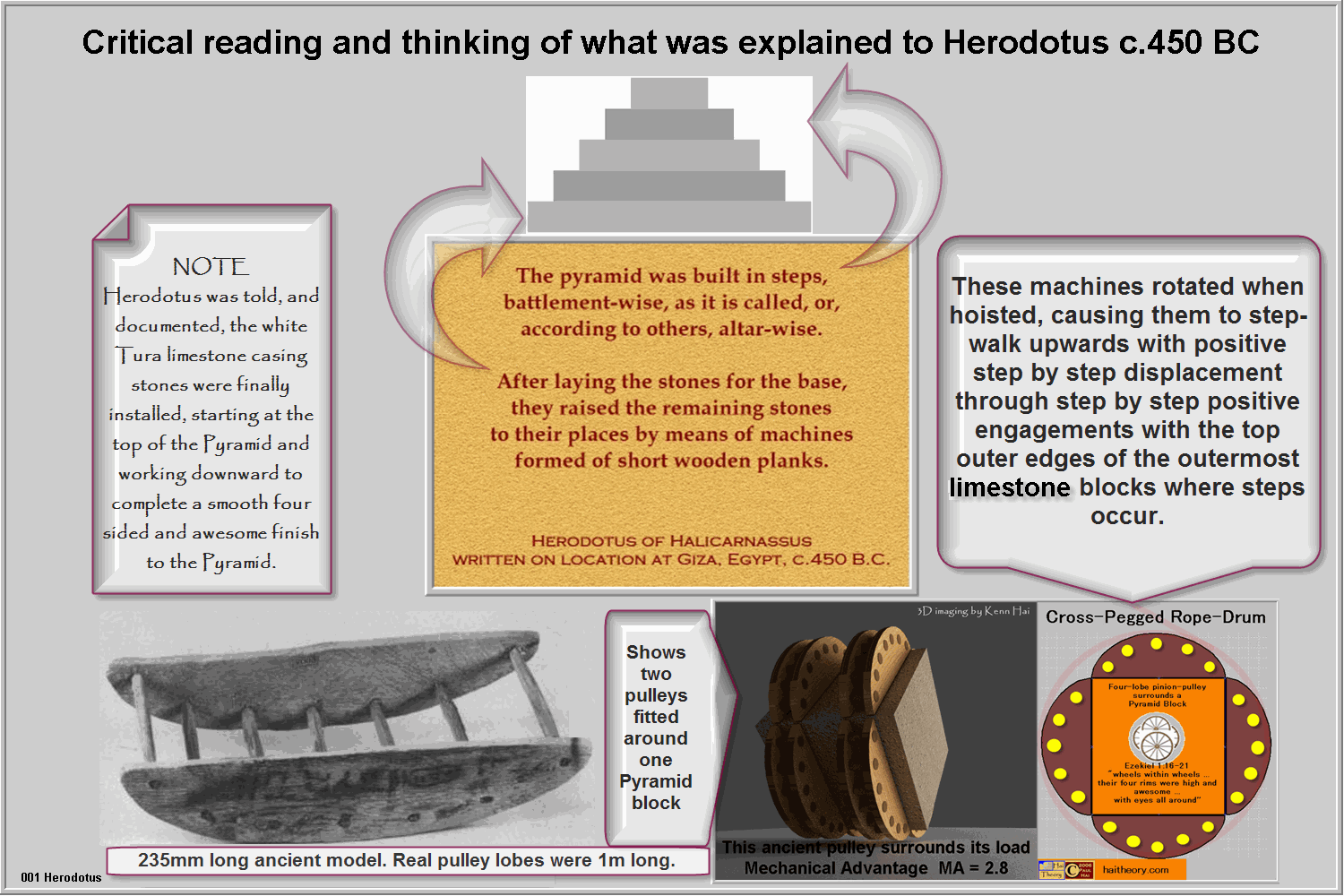
Just as human-beings walk upward on steps, step by step, Giza engineers raised Pyramid blocks step by step, thereby using all space available over the entire Pyramid’s four sides progressively until completion.
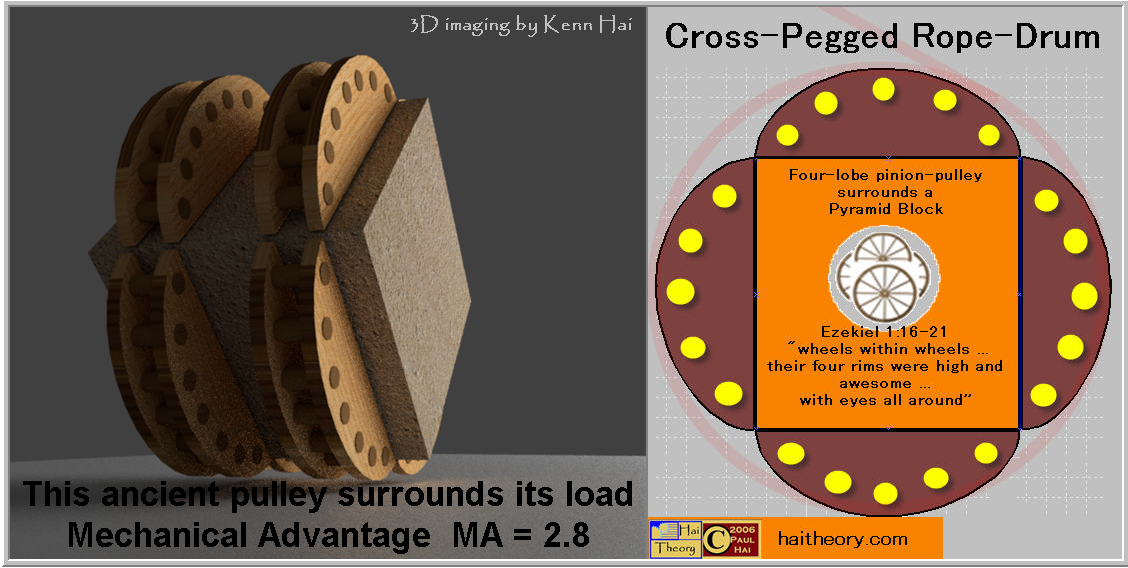
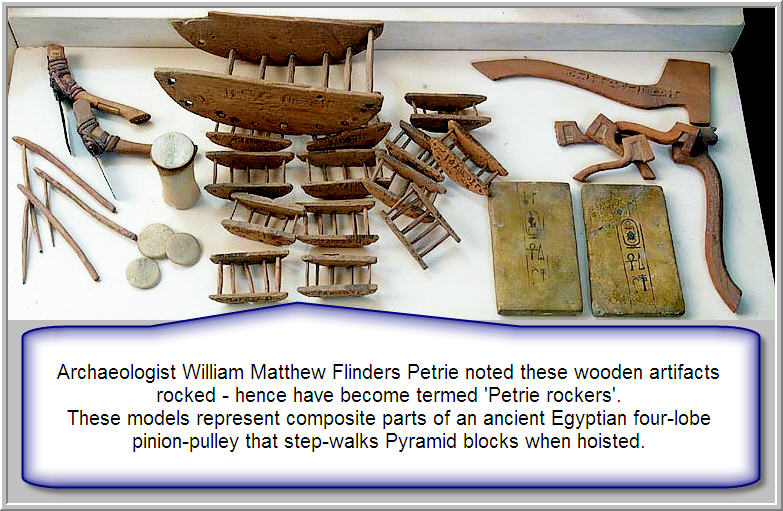
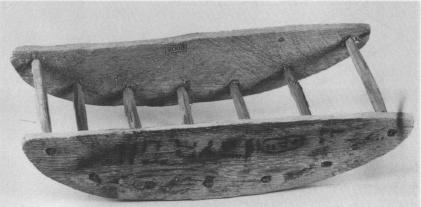
Tomb models of “Petrie rockers” provide evidence of the “four‑lobe pinion‑pulley” which surround a Pyramid block and step walks its load when hoisted.
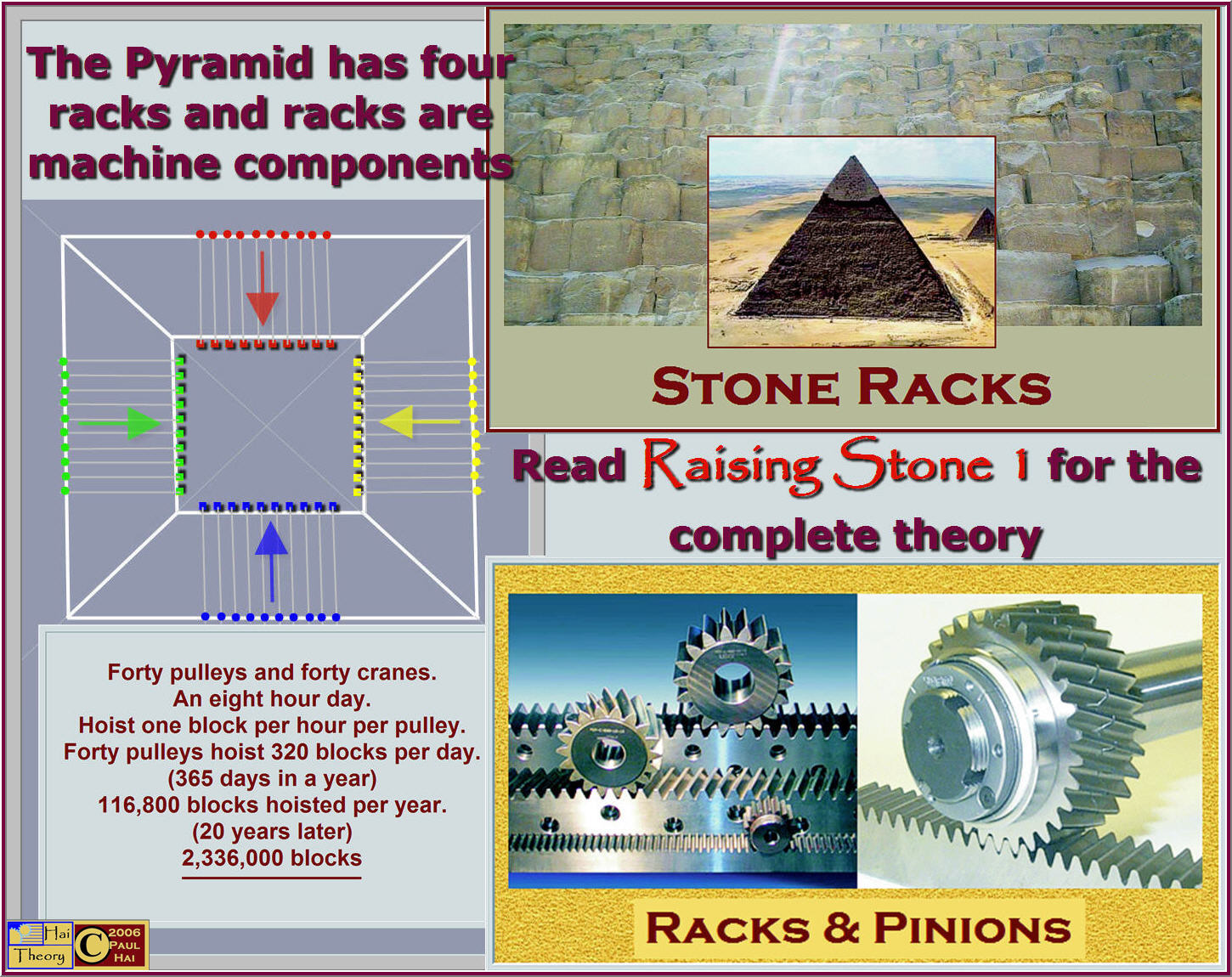
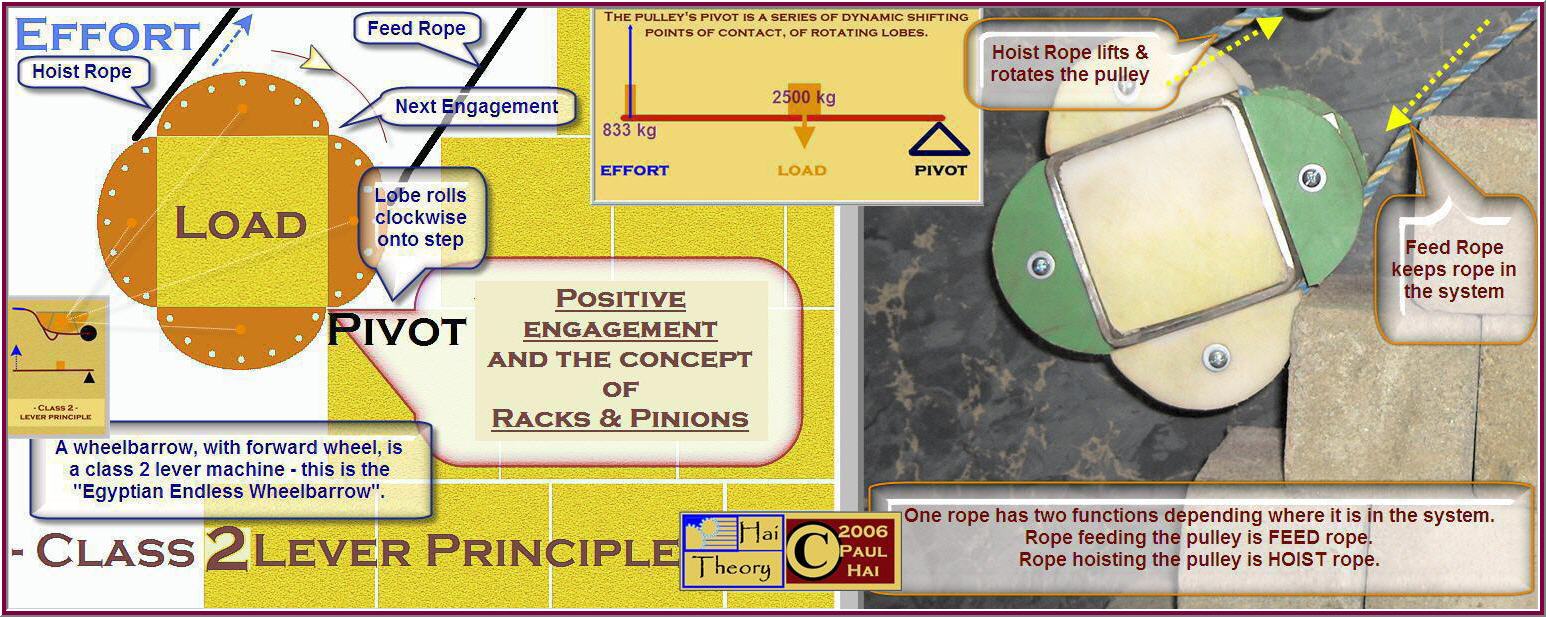
Giza Pyramid builders used the earliest known example of “Rack and Pinion” engineering technology, where the Pyramid consists of four sides of Limestone Racks (steps) and Four‑Lobe Pinion‑Pulleys engaged Limestone Racks (steps) with positive displacement when hoisted.
Click on the video below to see a model demonstration
Click here to go to my YouTube Channel
https://www.youtube.com/@haitheory
My name is Paul Hai and my website deals with ancient text documentation which tell us how the Pyramids of Giza were constructed.
The first document is found in the Old Testament of the Holy Bible, written by Priest Ezekiel c.590 BC.
The second document is written by Herodotus, a Greek historian widely regarded as being "the father of history".
Herodotus asked many questions in his travels and recorded what he was told. In c.450 BC the Giza priesthood personally told Herodotus what they knew of Giza Pyramid construction.
This website deals with ancient knowledge only and wholly refutes all modern Giza Pyramid construction theories as nonsense and/or not feasible. Those who have read "Raising Stone 1" have a head start in understanding the information given and others will need some patience in understanding the explanations and verifications of ancient Egyptian Pyramid engineering techniques.
The ancient documents mentioned are critical for proof and primary source documentation, when and where it exists is demanded at university level research studies. Unfortunately many university professors have concluded the Herodotus documentation is false regarding wooden machinery being used to construct the Great Pyramid and this has led to a steady flow of people intent on putting forward their very own ideas and what has resulted is a free for all of mostly complete and utter nonsense.
After I established the Herodotus documentation to be truthful, I then turned my attention to the machines mentioned in the Old Testament of the Holy Bible in Chapter 1 of the Book of Ezekiel to find the subject of the writing difficult to comprehend, but have found common ground throughout the twenty eight verses.
The descriptions in Ezekiel confirms the use of excavated wooden wheel lobes known to many as "Petrie rockers".
Anyone who is serious about understanding Giza Pyramid construction technique should limit themselves to three sources of study; Ezekiel Chapter 1, Herodotus - The Histories - Book 2 - Egypt and my book "Raising Stone 1" which is an engineering dialogue, or at least use this website as a study guide.
Ezekiel appears to write metaphorical nonsense and this may have been intentional as knowledge did and still is powerful.
Reading studies begins with Ezekiel Chapter 1, verse by verse unless where some verses are repetitive.
If my reader decides to opt for modern theories promoting ramps and kites and such, of which there is an abundance, but all totally unstructured toward a critical result, there you will be lost. Lots of hot air out there and talk is cheap, so begin studying for what you wish to understand and listen carefully to what the ancient people have documented through their scribes.
The answers are here, but patience, alertness, critical thinking and fortitude are required.
The convergence of Ezekiel Chapter 1 circa 590 BC with Herodotus - Egypt circa 450 BC
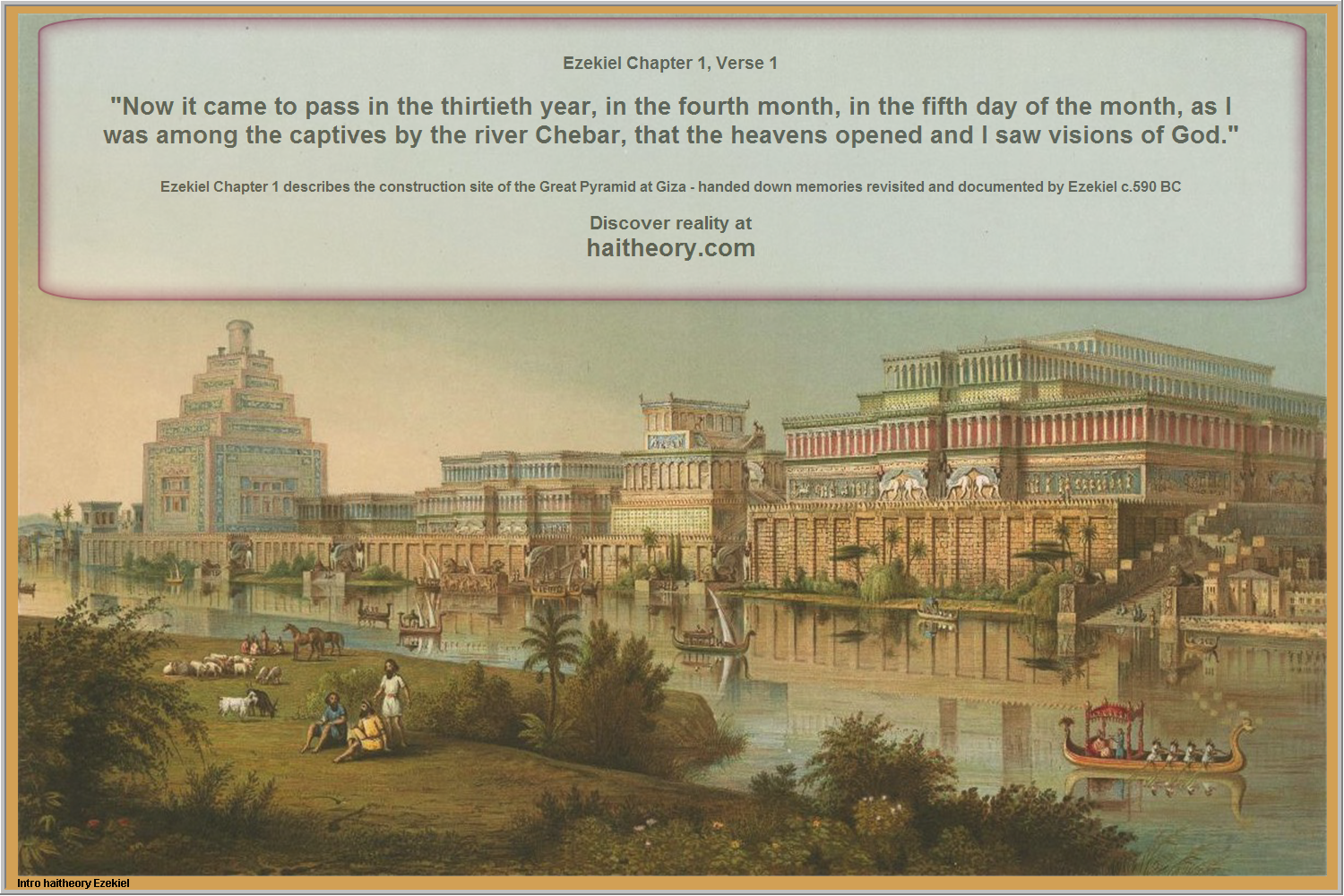
This story began on the banks of the river Chebar in Babylon c.590 BC with a group of people who met to tell what they knew of Giza Pyramid construction to their priest and scribe, who was known as Ezekiel.
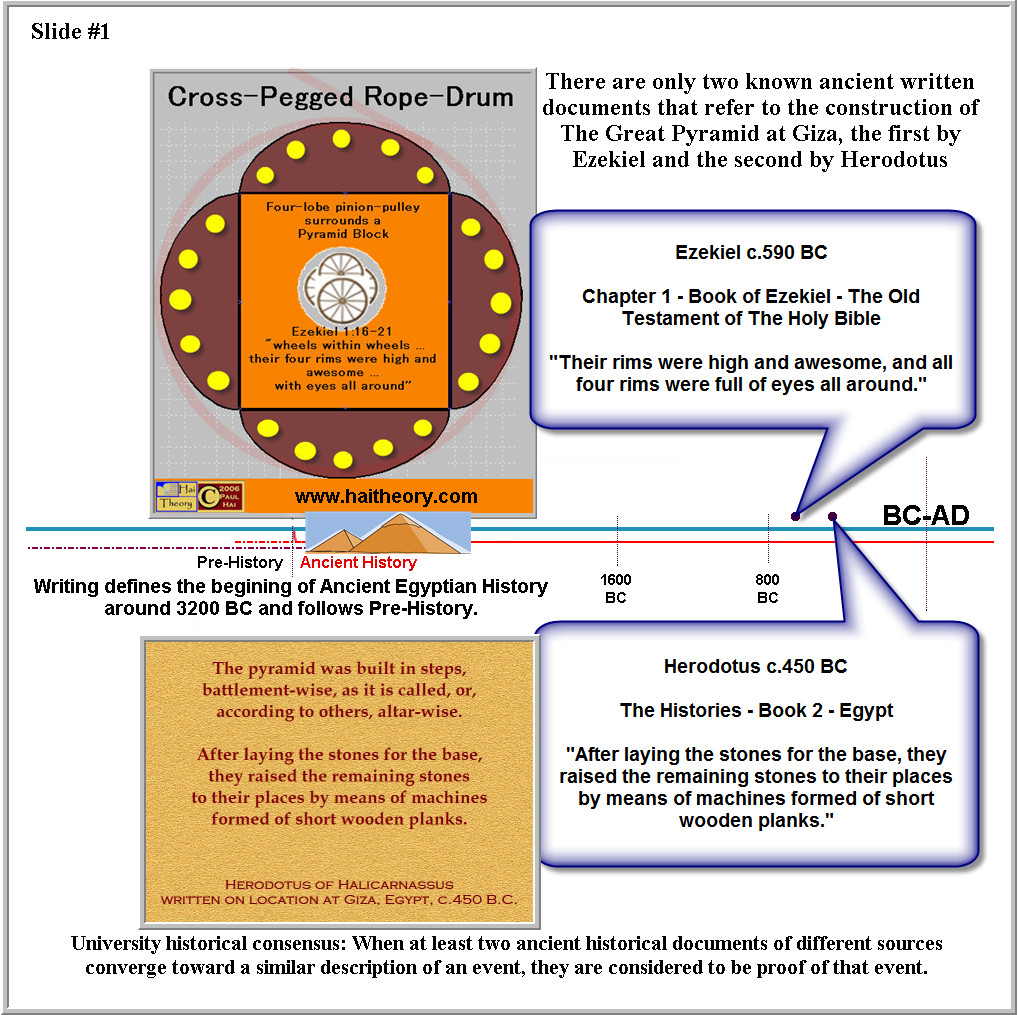
A TIMELINE runs midway horizontally and is focused on 590 BC and 450 BC. The Giza Pyramids are shown on the timeline around 2600 BC. The top half deals with Ezekiel and the lower half deals with Herodotus. Be patient for the explanation of the machinery which involves real artifacts.
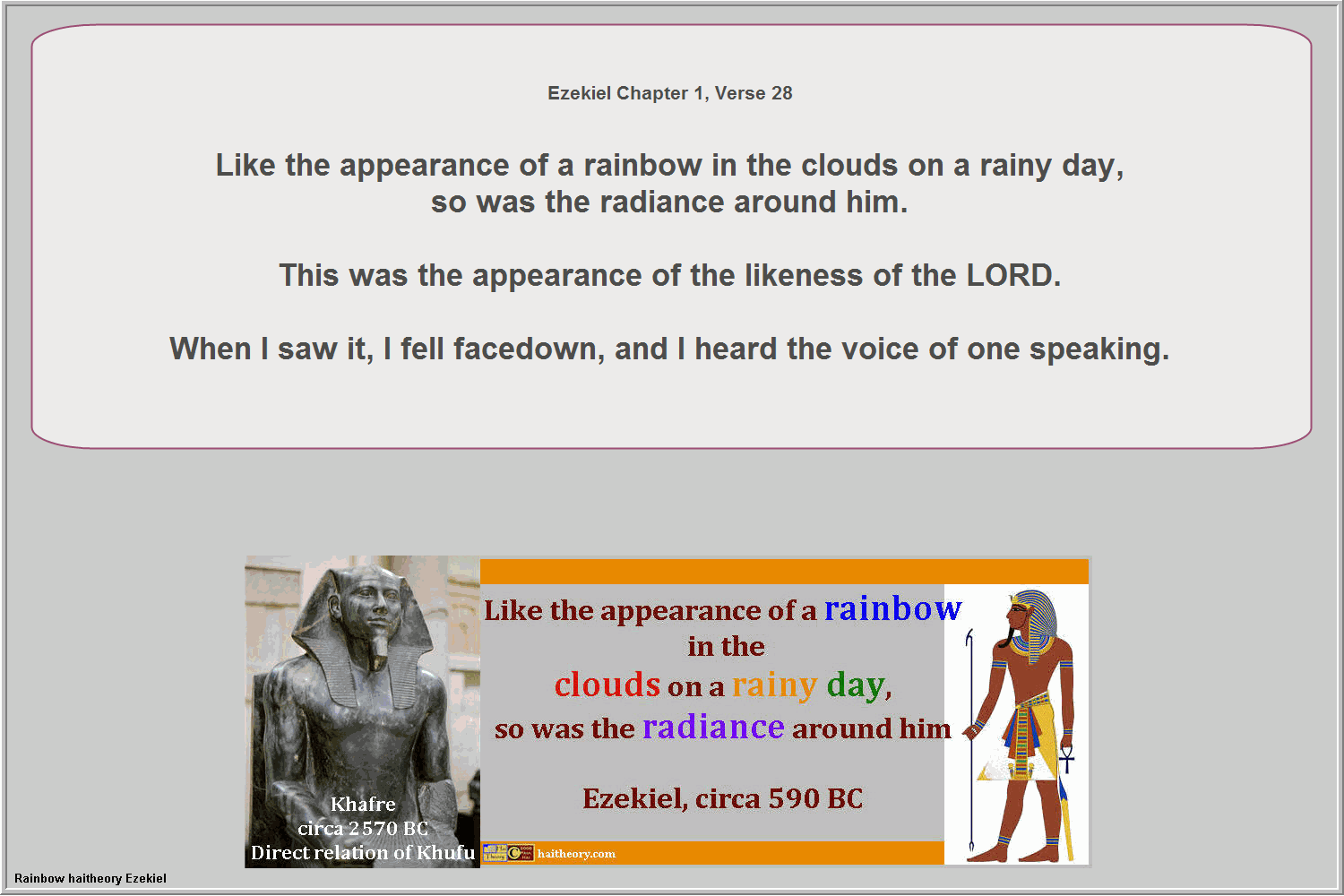
The Egyptian god here was Ra, the Sun god. The Pharaohs of the Giza Pyramids described themselves as 'Sons of Ra'.
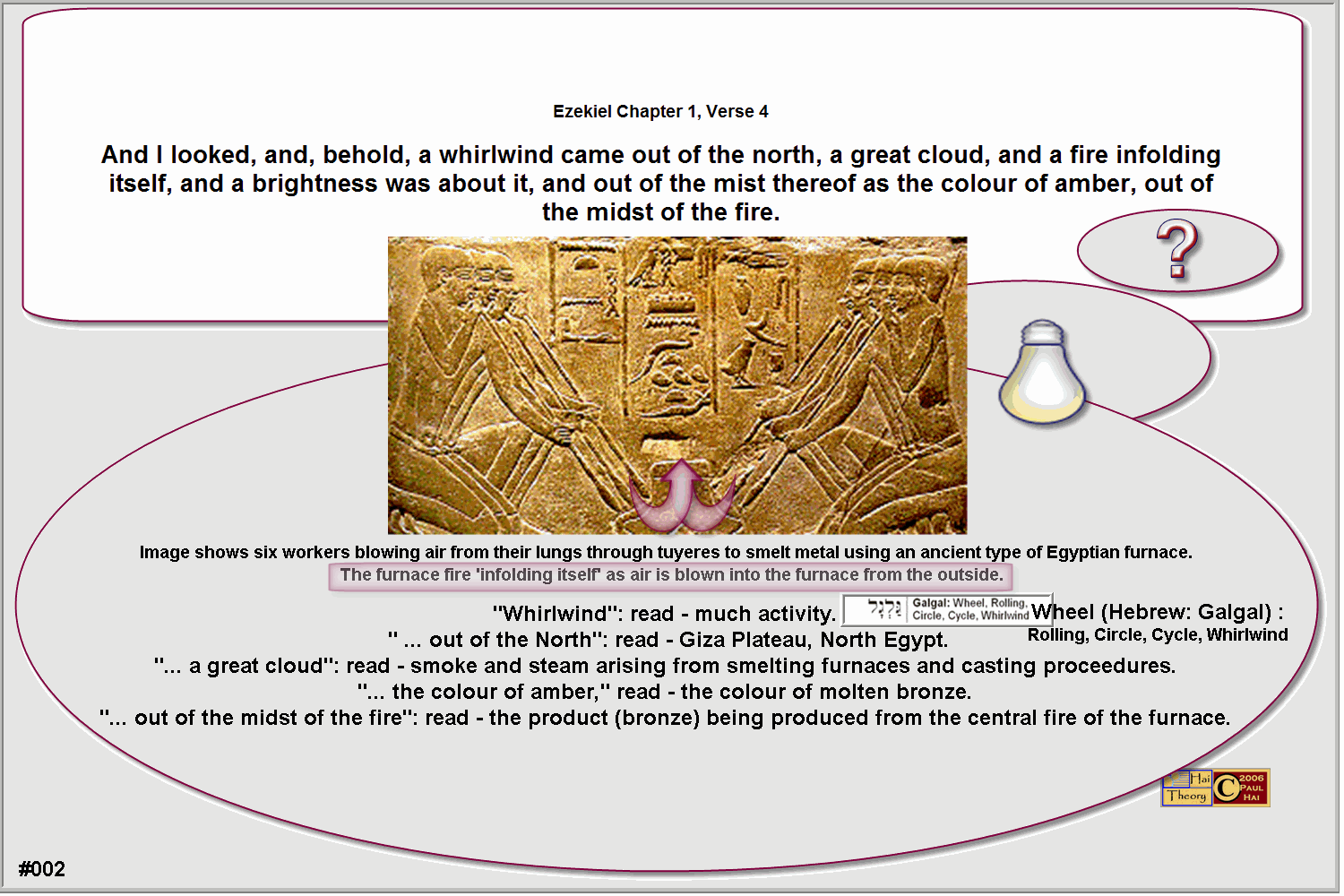
Six workers use air from their lungs, blowing through tuyeres to provide a smelting temperature for bronze in the central furnace. The furnace fire infolds as they do this. Bronze was cast for tools and equipment such as chisels and feet for claw-lifts.
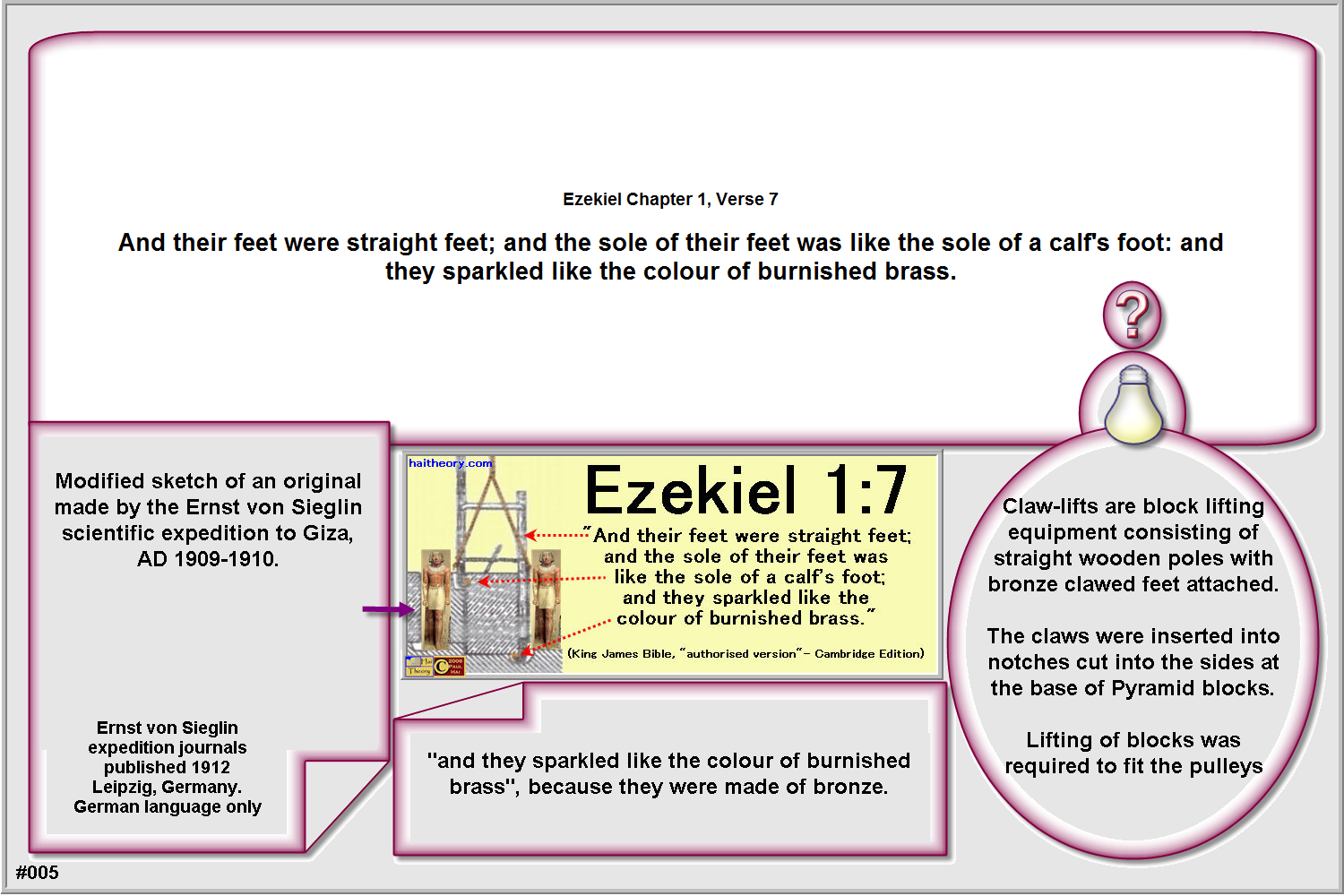
Claw-lift feet were attached to long straight poles and were required to lift stone blocks for pulley fitting. Evidence for this includes the Ernst von Sieglin scientific expedition to Giza AD 1909-1910 and Ezekiel Chapter 1, Verse 7.
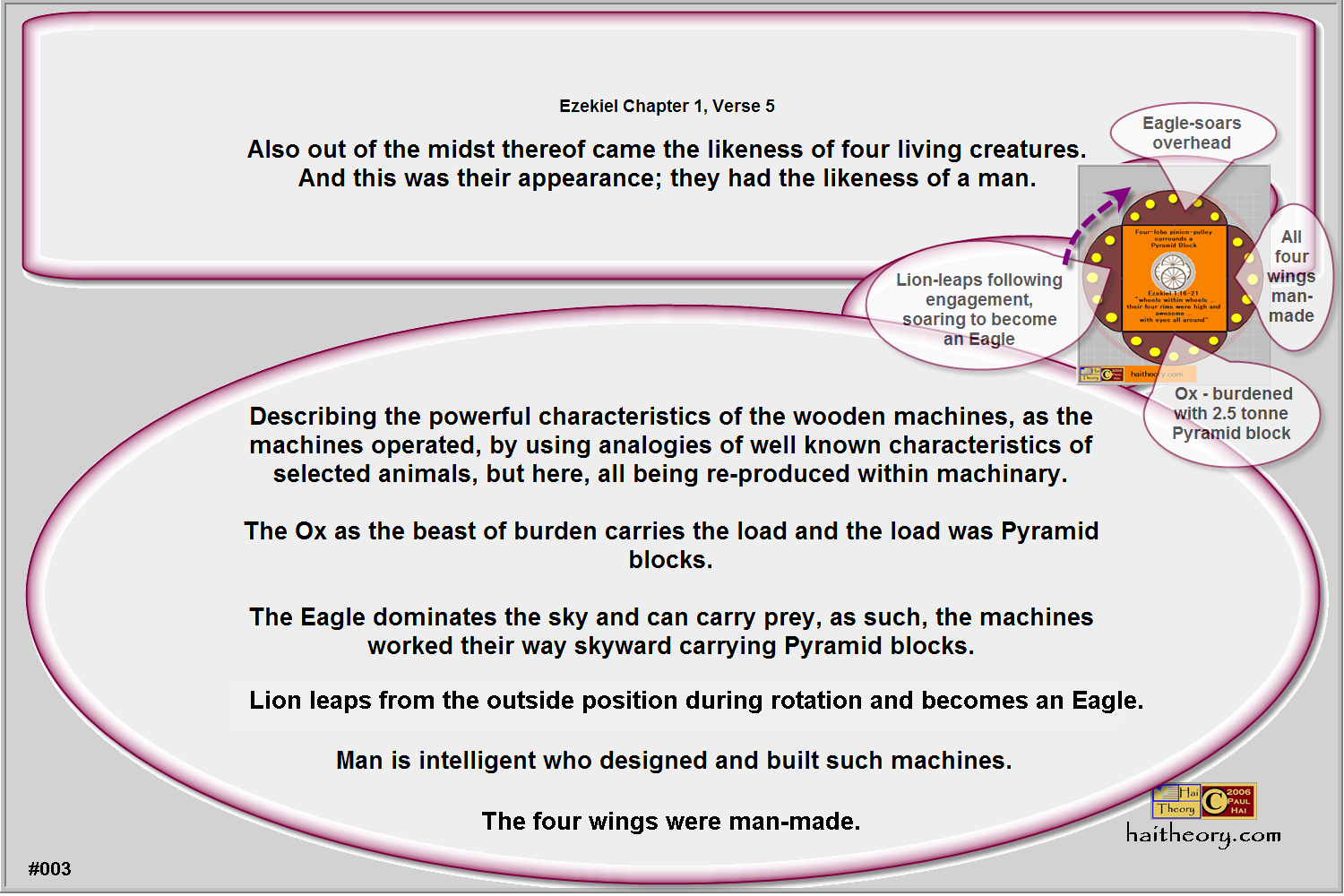
Living creatures means moving, in motion, rotating and climbing, dynamic. Machinery in motion. Machinery working. The creatures are the machines.
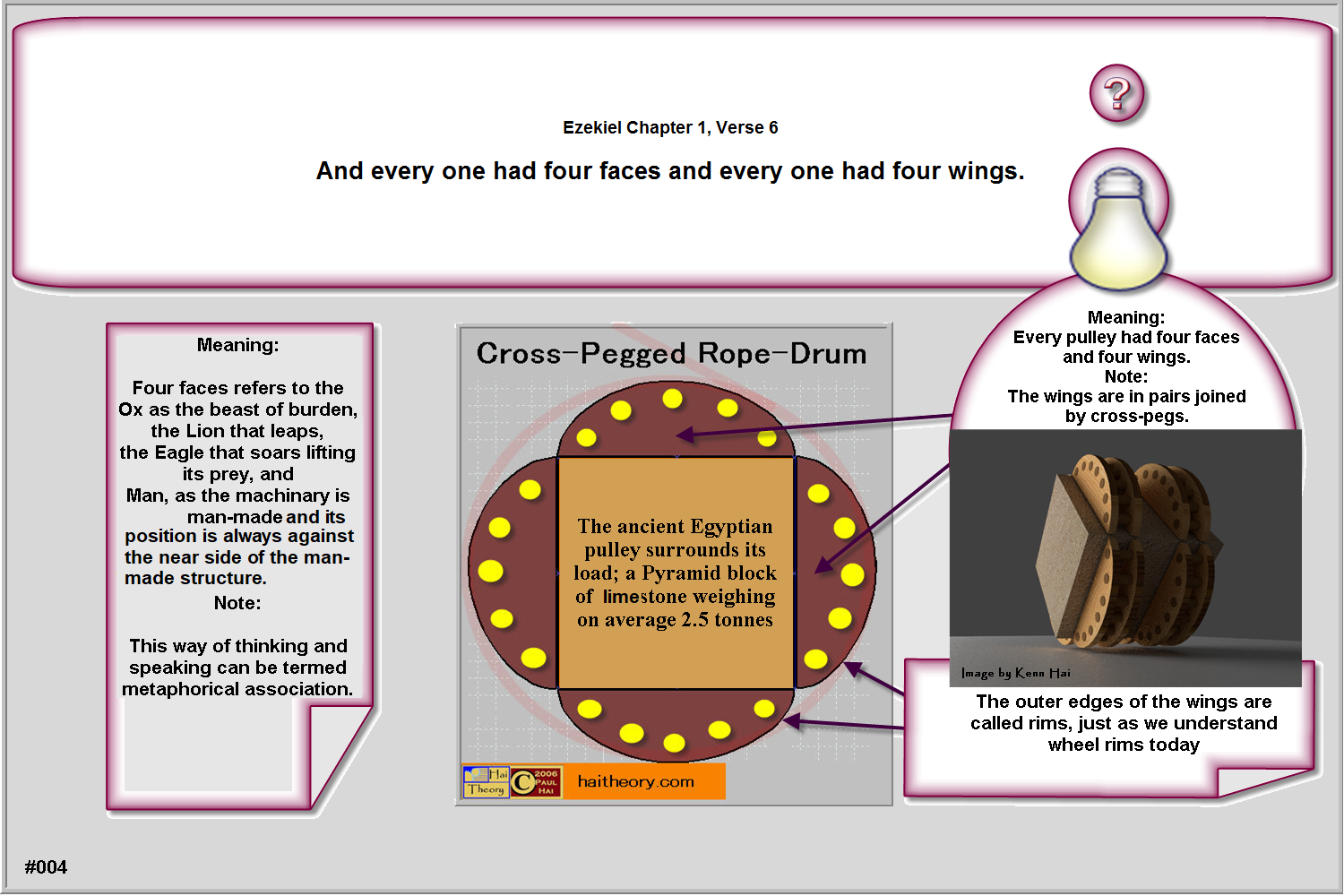
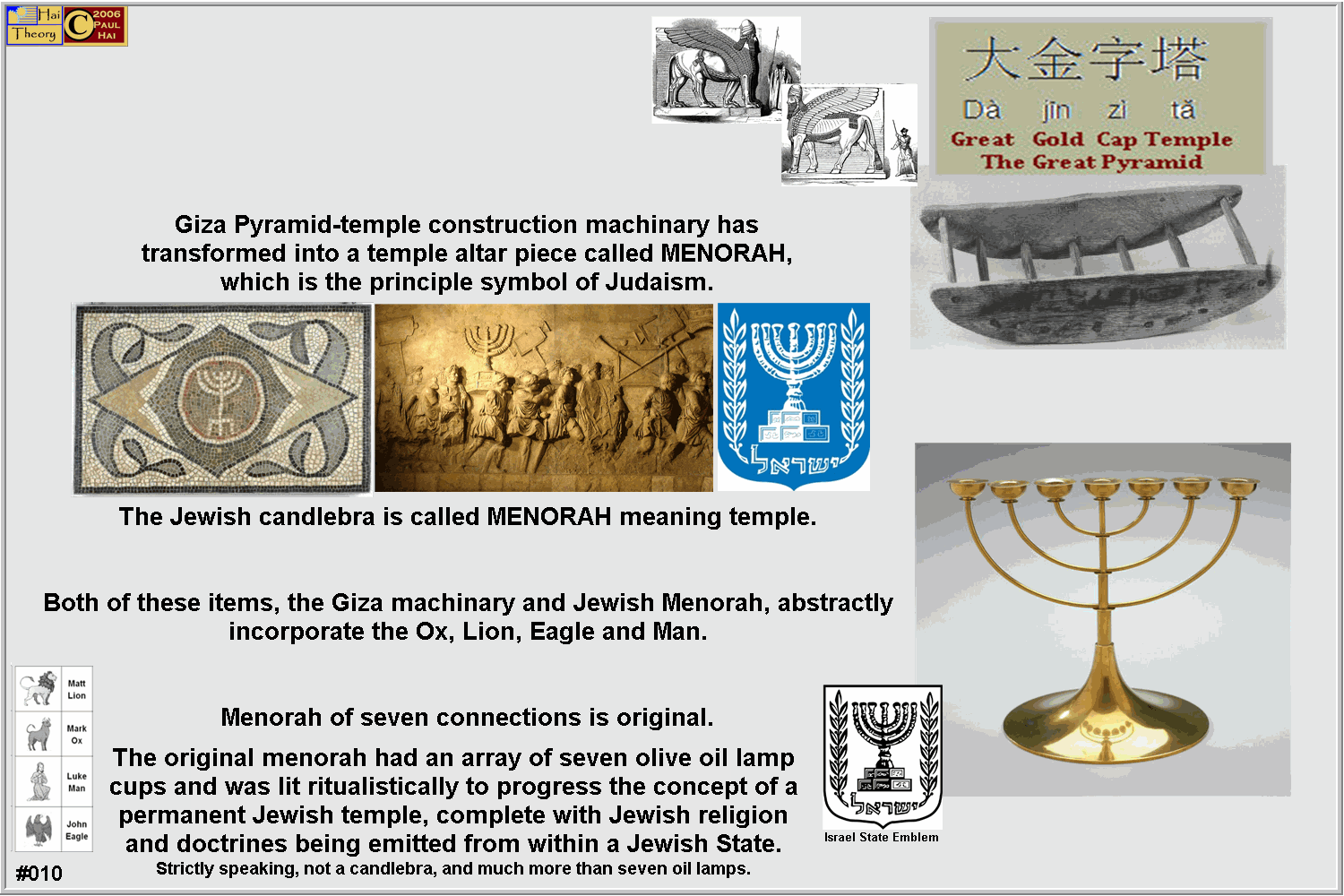
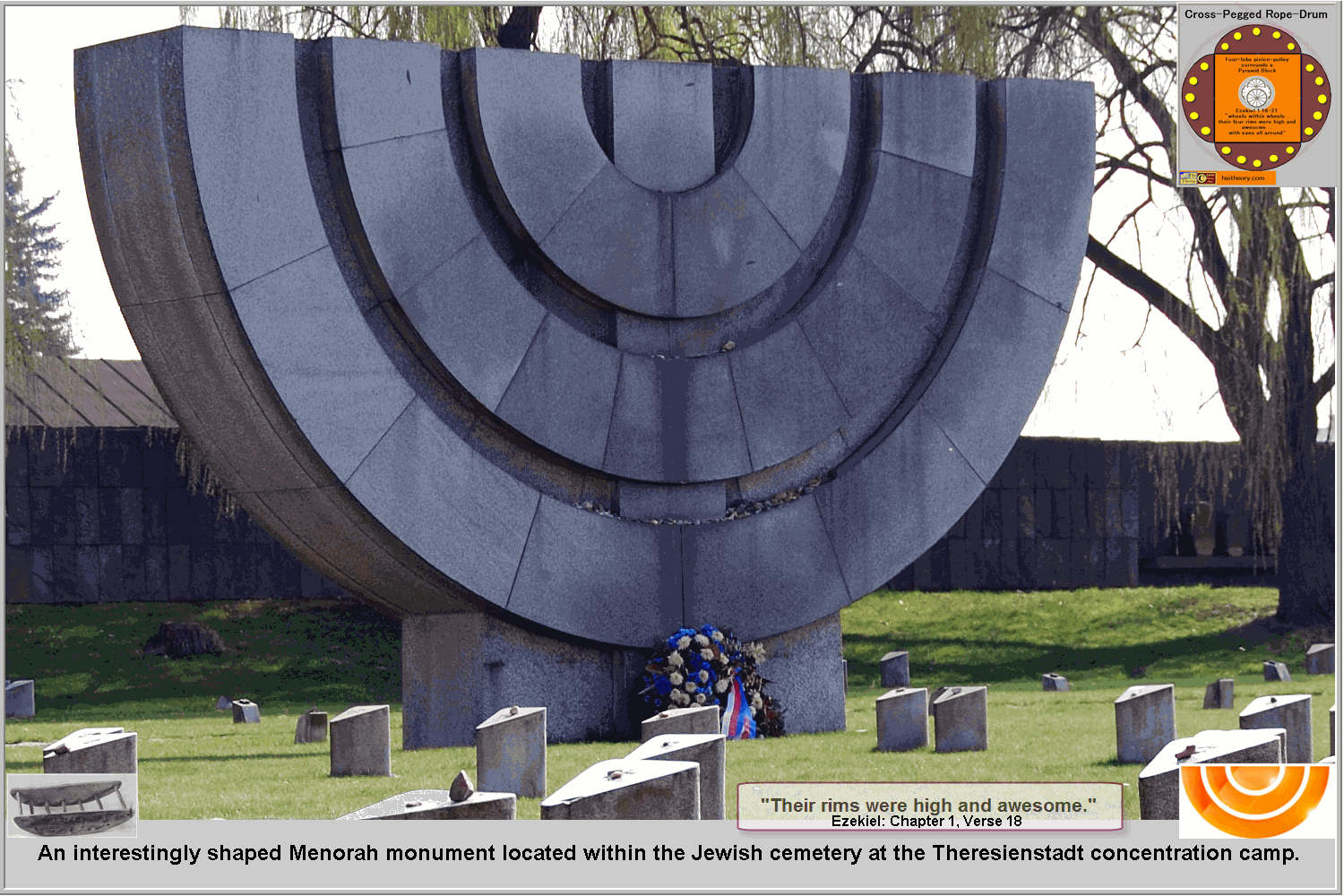

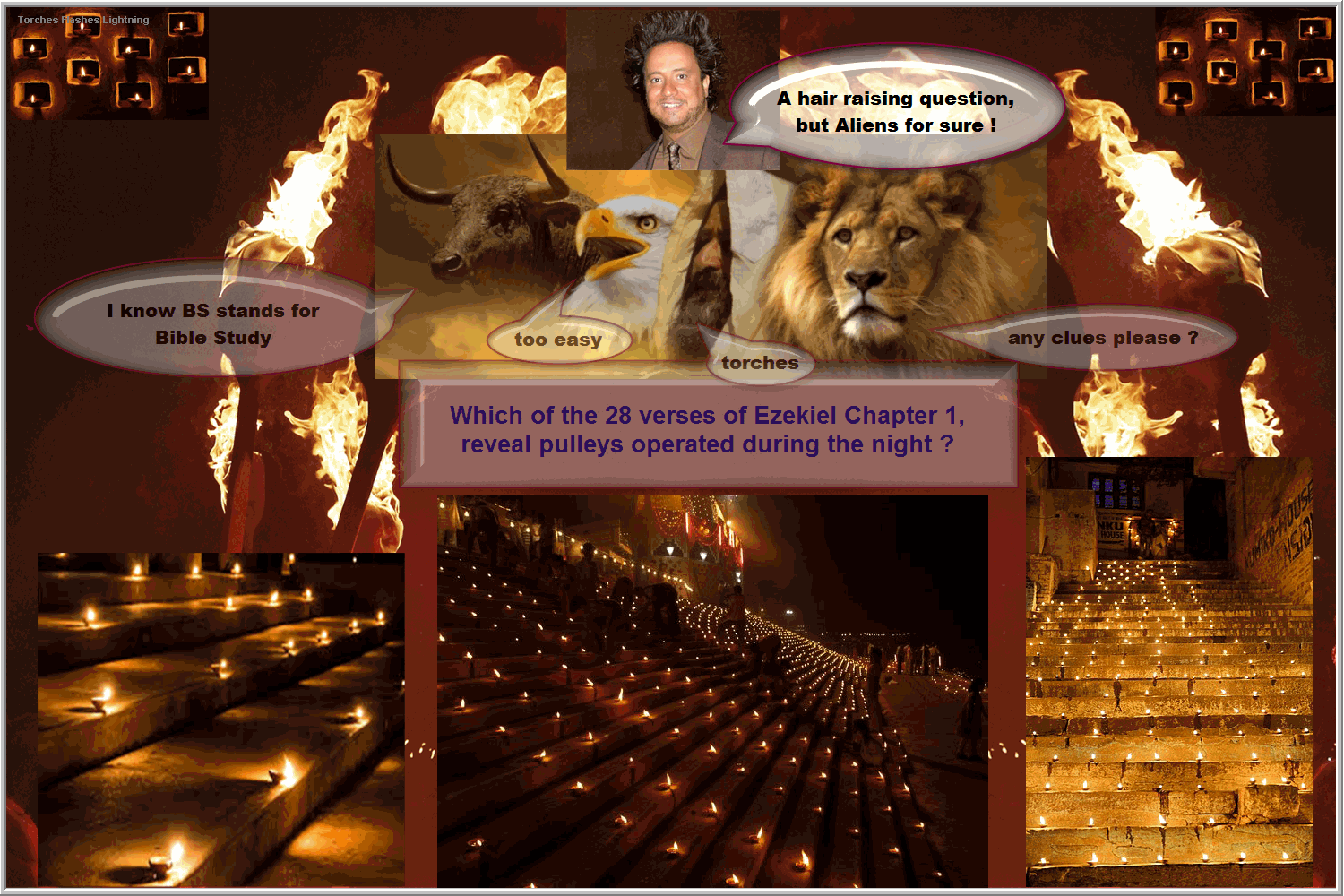
The "Festival of Lights" celebrated in India. A festival of lights is also celebrated in Egypt and is dedicated to Goddess Neith. Goddess Neith is inscribed on Inty Shedu's tomb statue.
At the times when they gather together at the city of Saïs for their sacrifices, on a certain night they all kindle lamps many in number in the open air round about the houses; now the lamps are saucers full of salt and oil mixed, and the wick floats by itself on the surface, and this burns during the whole night; and to the festival is given the name Lychnocaia (the lighting of the lamps). Moreover those of the Egyptians who have not come to this solemn assembly observe the night of the festival and themselves also light lamps all of them, and thus not in Saïs alone are they lighted, but over all Egypt: and as to the reason why light and honour are allotted to this night, about this there is a sacred story told.

At least TWO historical documents which converge about an event are required by universities as reasonable proof about that event. TWO historical documents concerning Great Pyramid construction are listed below.
Ezekiel 1-28 decoded via the re-discovery of ancient Egypt's four‑lobe pinion‑pulley (27 August 2006) via composite artifacts, proves Khufu's Great Pyramid was constructed with mass production techniques requiring well developed critical flow analysis for perfect completion within the documented twenty year time-frame. The four‑lobe pinion‑pulleys are Ezekiel's "wheels within wheels" machines. RAMPLESS Pyramid construction began with Pharaoh Sneferu's RED Pyramid at Dahshur, and later at Giza for the Pyramids of Pharaohs Khufu, Khafre and Menkaure. Please keep reading carefully - do not preempt anything until you have studied the ancient historical documents and ancient artifacts this re-discovery is very firmly founded upon.
Four critical pieces of historical evidence converge to one explanation ... multiple step-walking pulleys were used in a well organised mass-production frenzy ...
1 ... Existing Pharaonic models of the four‑lobe pinion‑pulley ... excavated AD 1895 ... one lobe handed to William Petrie onsite at Dier el Bahari for his Petrie Museum in London
2 ... Ezekiel historical document - c.590 BC ........... "Wheels within wheels" machines described in the Bible ... Old Testament ... information gleaned from exiles meeting at the Chebar River
3 ... Herodotus historical document - c.450 BC ...... absolutely correct reporting from what was personally gleaned from Egyptian priest historians in 450 BC
4 ... Numerous ancillary artifacts ... extremely strong papyrus rope ... integrated triple rope sheeves of stone ... 40 shiploads, each 150 tons, of Lebanese Cedar imported for the pulleys by Sneferu, Khufu's father (Palermo Stone)
These four Pyramids were constructed using a unique type of wooden pulley, hitherto unknown in the modern world.
The Pharaonic pinion-pulley operates on Class 2 lever principle (Effort-Load-Pivot) with a Mechanical Advantage of 2.8 (MA=2.8), therefore technically qualifies as a MACHINE. This jargon means that a 2500 kg Pyramid block can be hoisted with a lifting effort equivalent to 900 kg.
The pulley makes Pyramid construction effective and very efficient and without any need for ramps simply because the four stepped sides of the Pyramid are used progressively throughout construction.
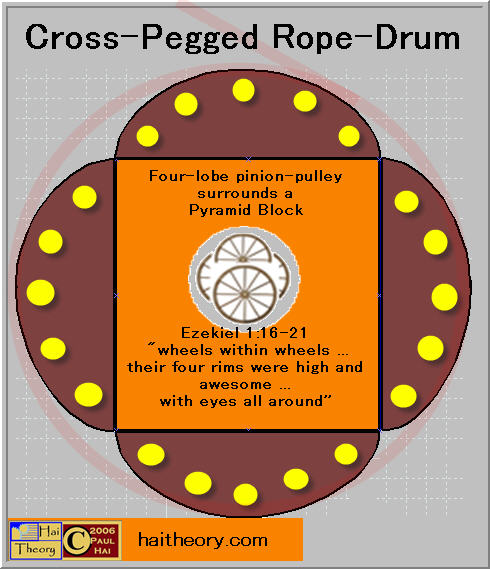
The MA (Mechanical Advantage) of this ancient pulley is = Output/Input or Load/Effort, which in this case is 2500kg/900kg = 2.8 ...... MA=2.8
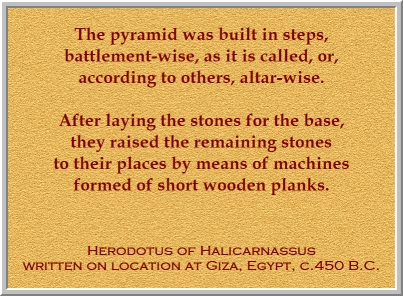
Herodotus reported absolutely correctly, however many people prefer anything but the truth. You see there is no mention of RAMP or RAMPS, so please ask yourself, why do the invented modern comedies of errors exist and are offered as ancient Egyptian history ! ?
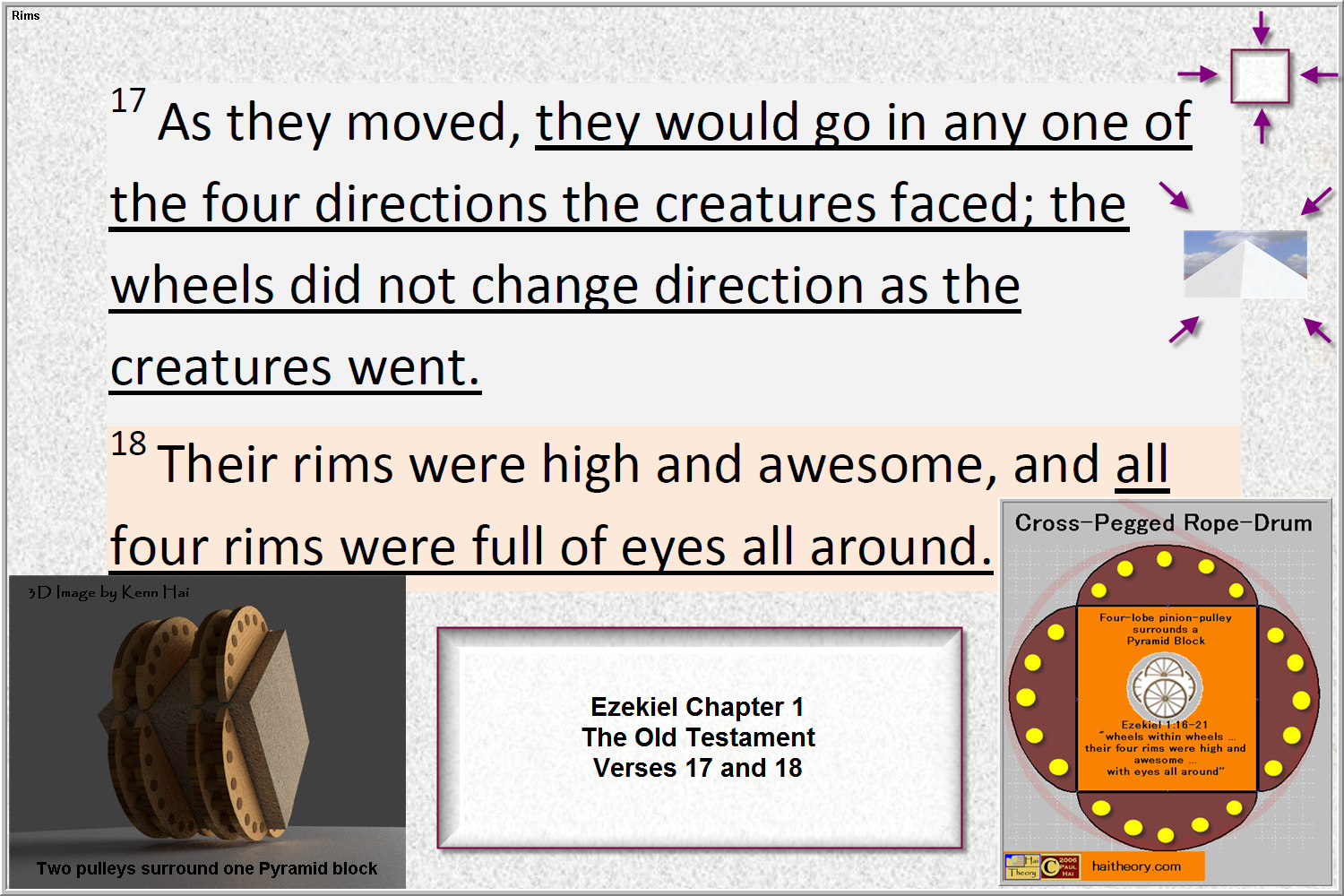
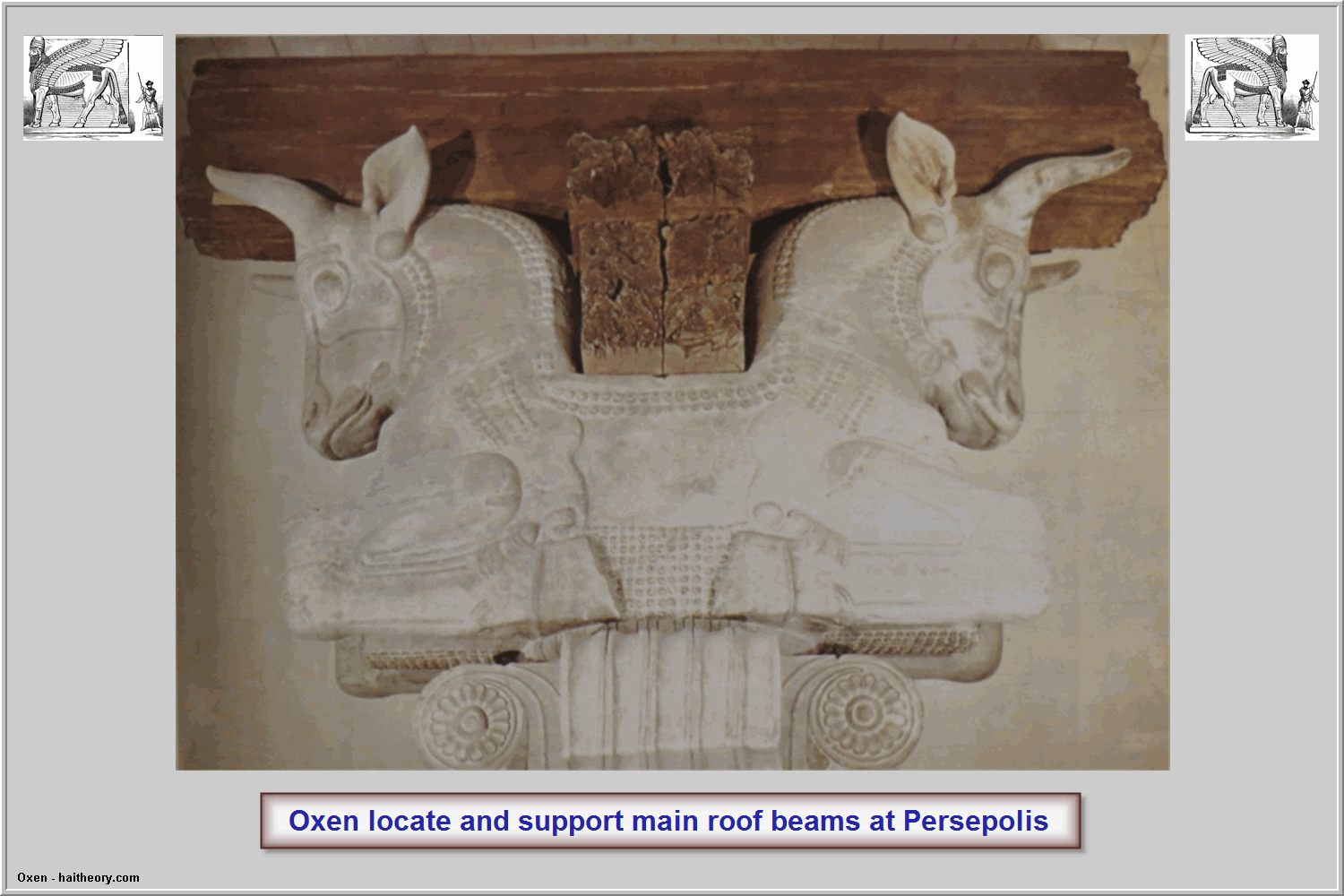
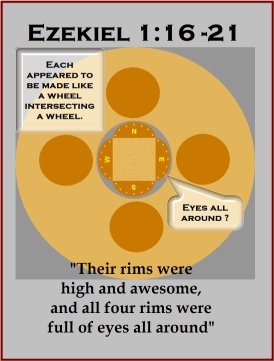
Ezekiel writes of machines thus,"their rims were high and awesome, and all four rims were full of eyes all around."
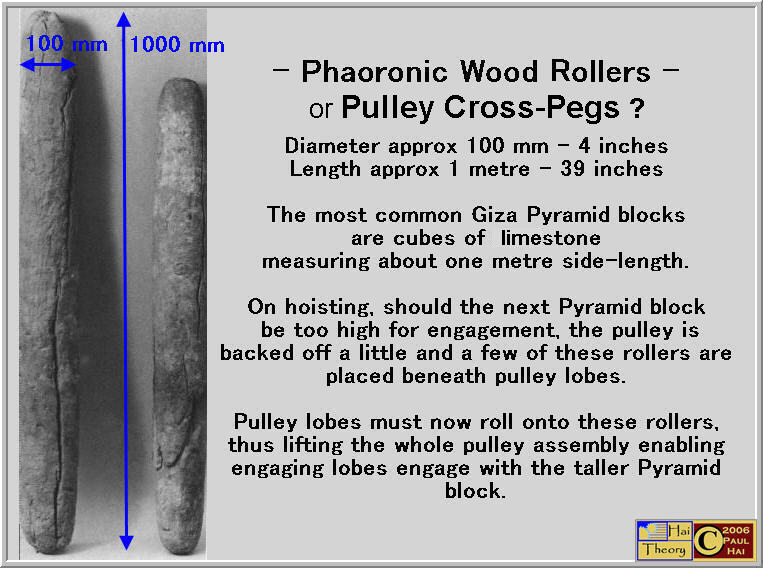
A Pyramid block with pulleys fitted is about one metre wide and one and a half metres high. When numerous pulleys were ascending the Pyramid during the cool of night by firelight, the scene would certainly be high and awesome.
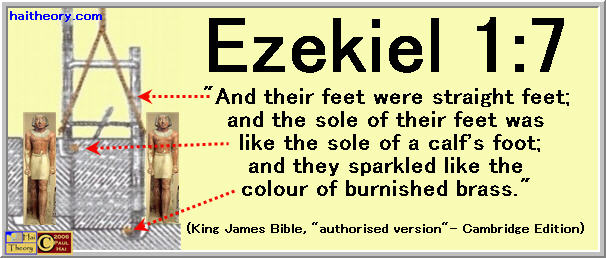
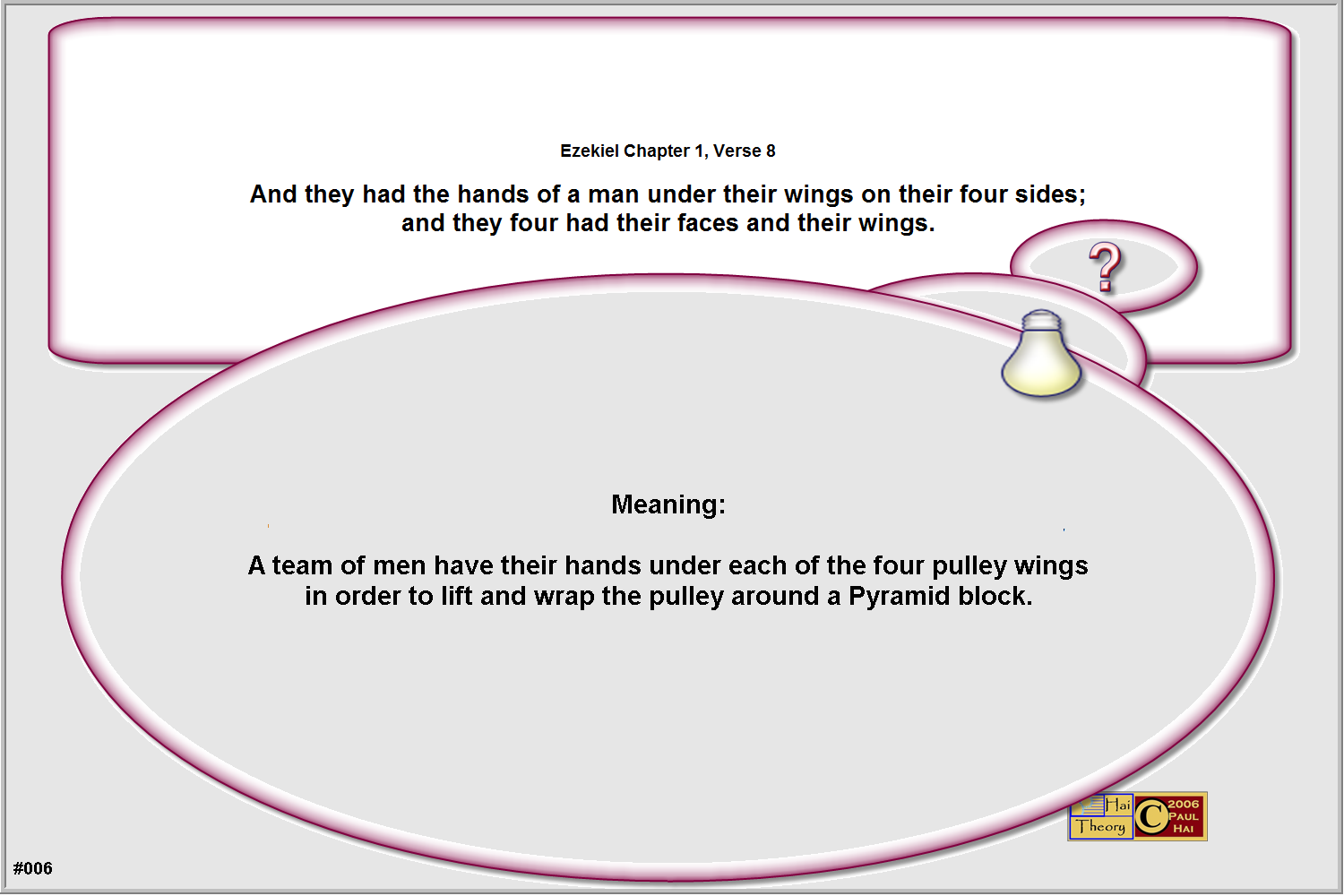
Ezekiel writes of what appears to be the lifting devices used to fit the pulley lobes (faces with eyes all around/wings) which he writes are straight with a calf shaped foot made of bronze.
"And this was their appearance: they had the form of men, but each had four faces, and each of them had four wings. Their legs were straight, and the soles of their feet were like the sole of a calf's foot; and they sparkled like burnished bronze."
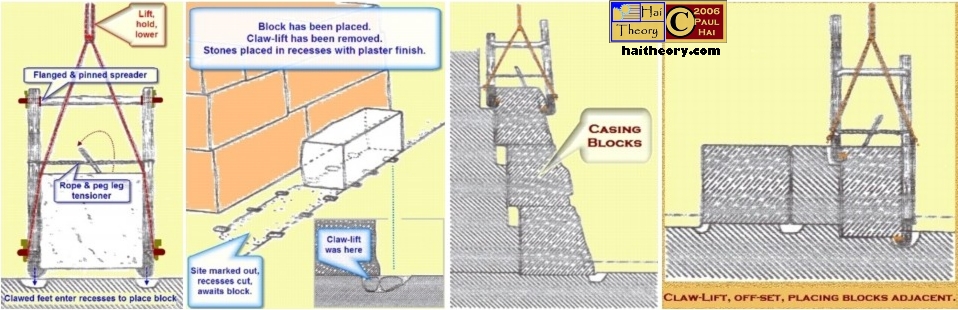
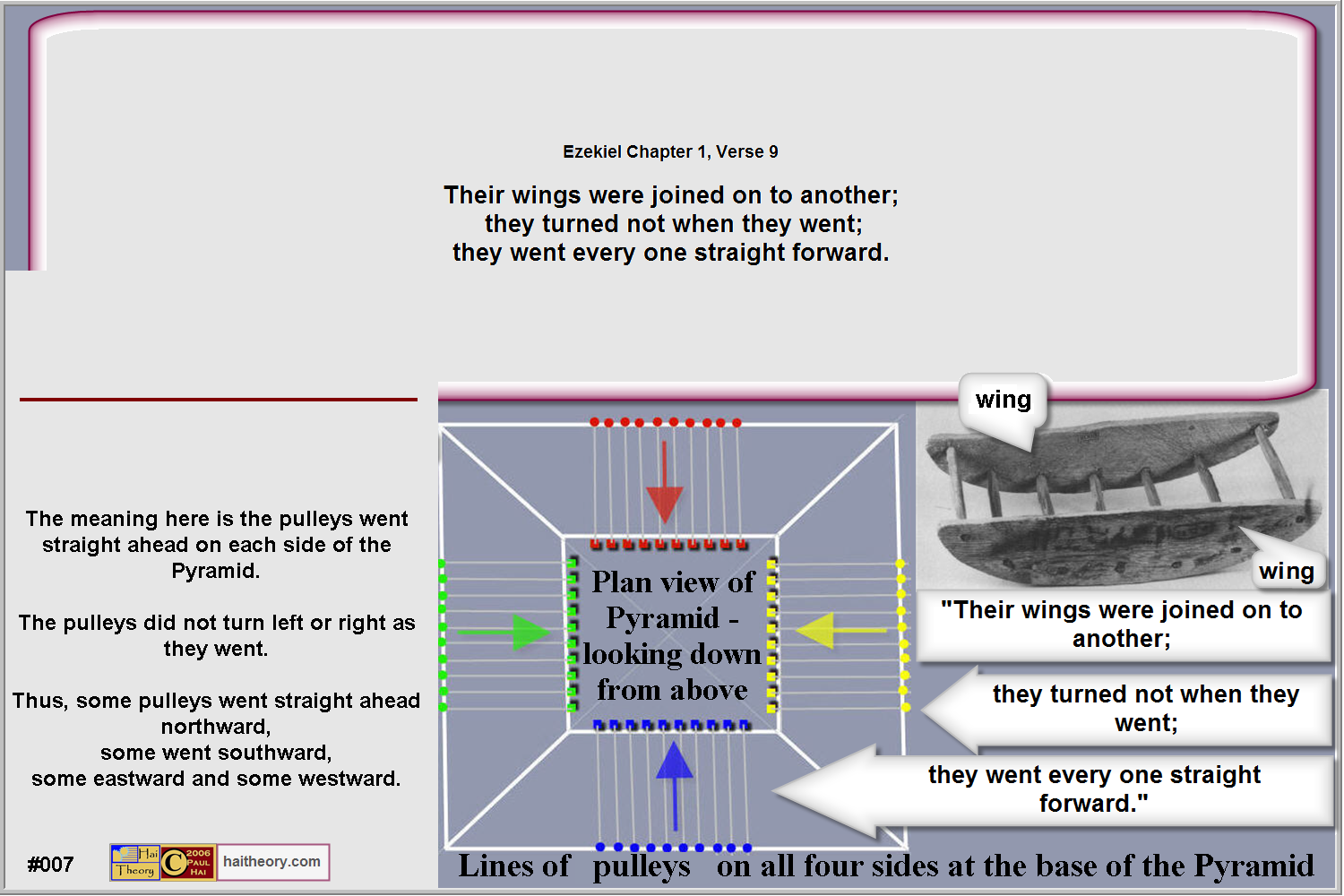
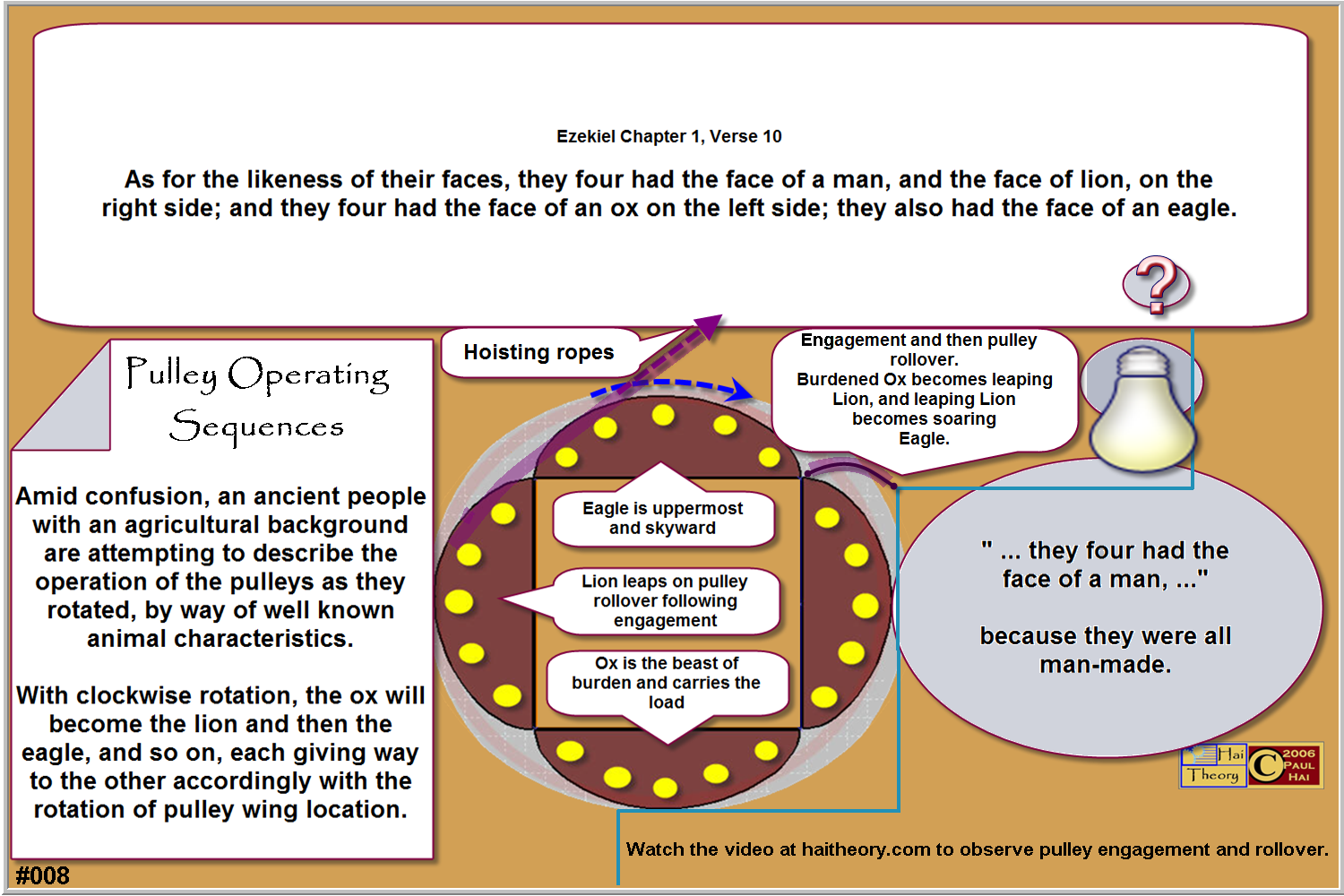
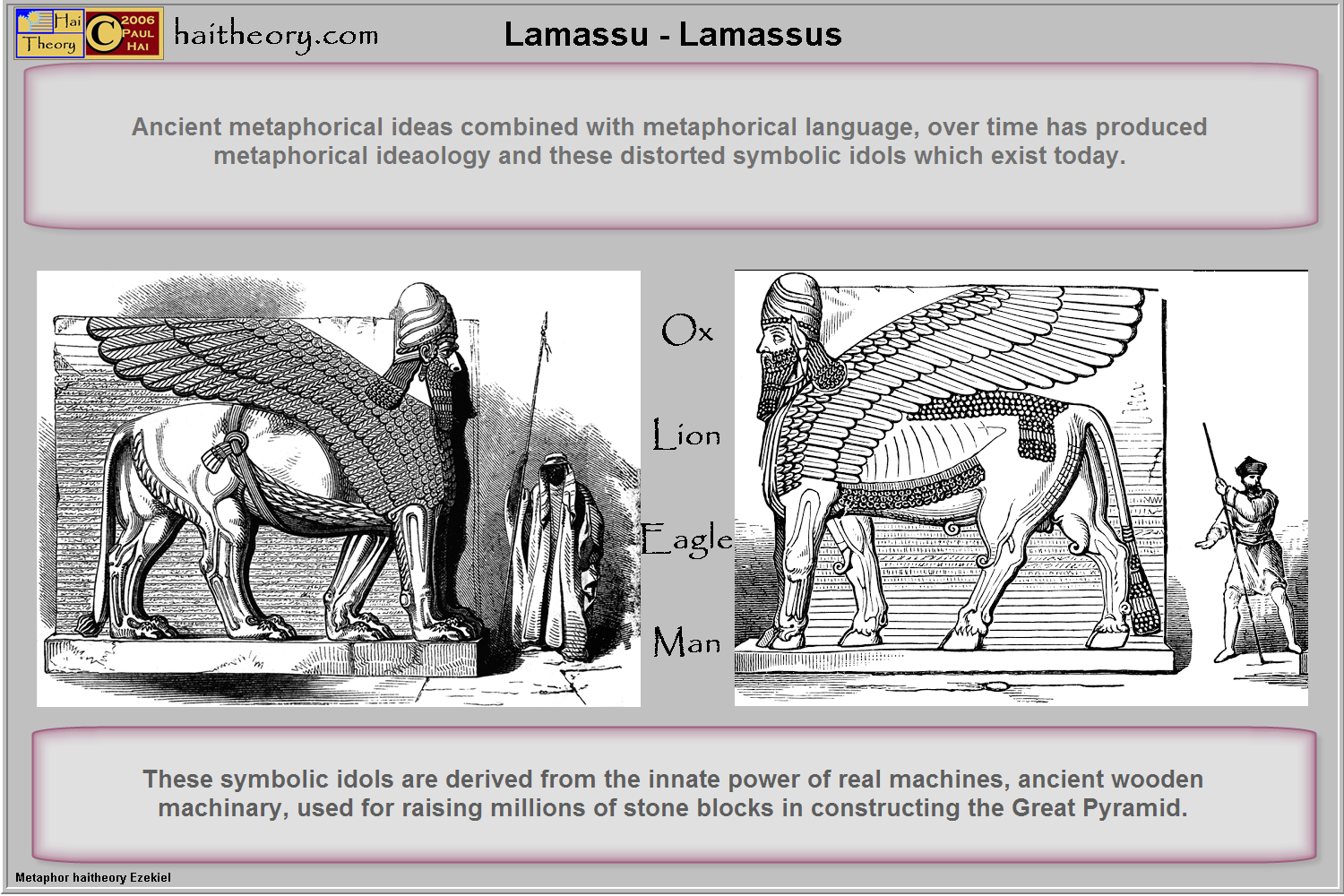
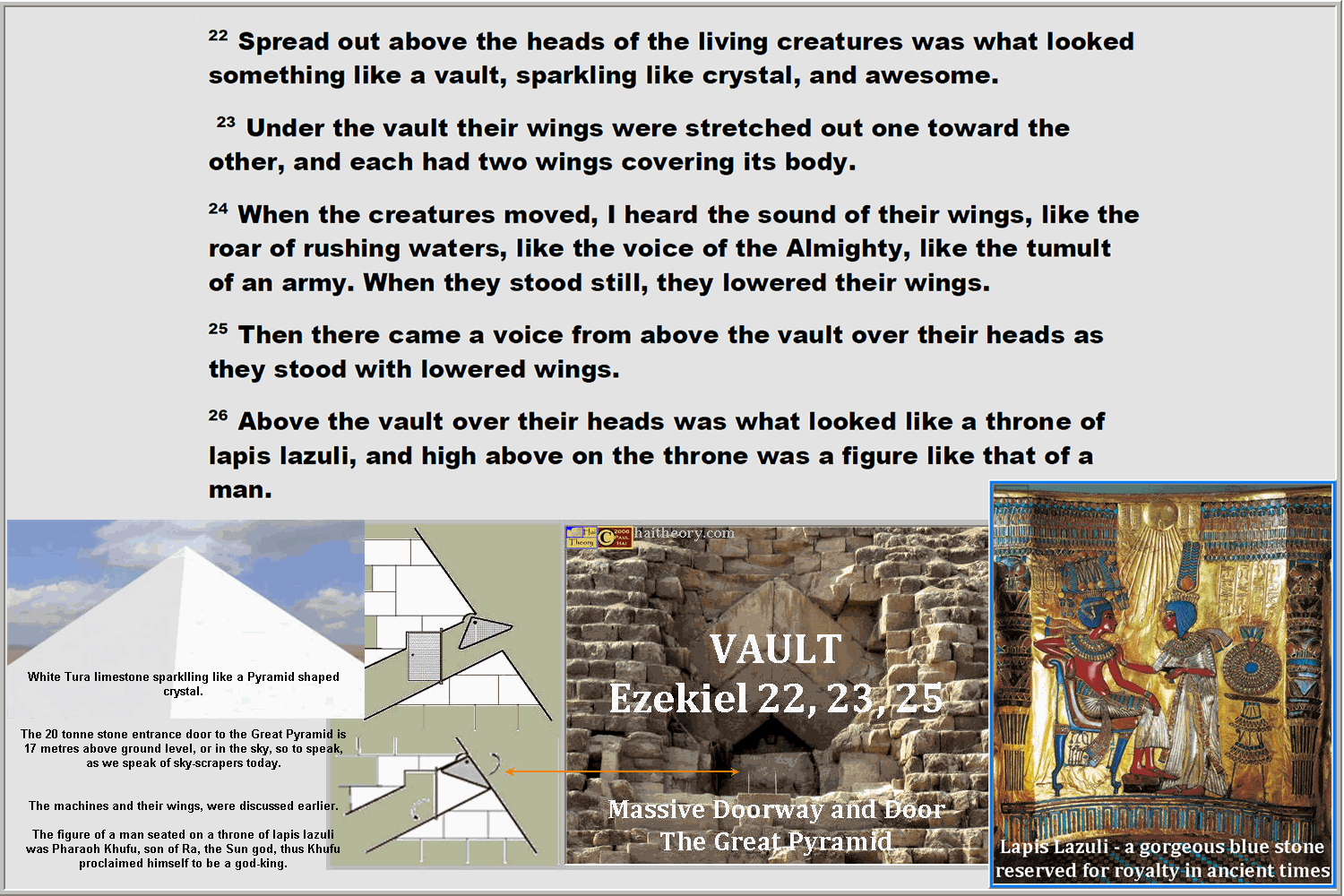
These devices are known as "clawlifts" and are fully explained in the book, RAISING STONE 1. I suspected the clawlifts were made of timber and their feet strengthened with bronze plates. There is no need to consider Ezekiel mentally sick and there is no need to entertain any ideas of UFO's and aliens. The building of the Pyramids was a dramatic event of ancient times using the latest technology involving machinery. This machinery was designed and manufactured by MAN, and having the strength of an OX, could soar like an EAGLE and leap like a LION. The four faces are the associated attributes of the machinery itself. The CHERUBS are the pulleys climbing as if alive and their WINGS are the pulley lobes which touch each other as they are tied together around a beryl coloured limestone block to be part of the THRONE. The THRONE is the Pyramid. The NOISE and WHIRLWIND refer to much activity onsite at Giza. (This ancient bible documented report is dated c.590 BC)
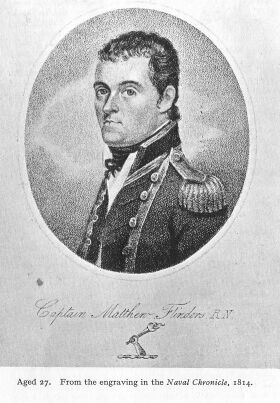
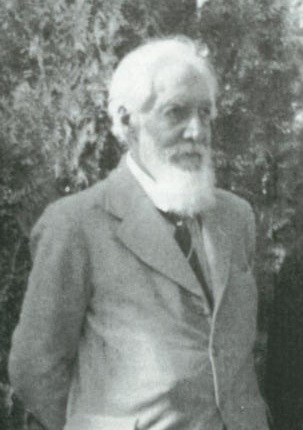
Captain Matthew Flinders (1774 ‑ 1814), famous navigator and cartographer of Australia's coast. Flinders suggested the name "Australia" which was adopted in 1824. His grandson became a leading excavator and curator of Egyptian artifacts known to everyone as "Petrie". He became Professor Sir William Matthew Flinders Petrie (1853 ‑ 1942).
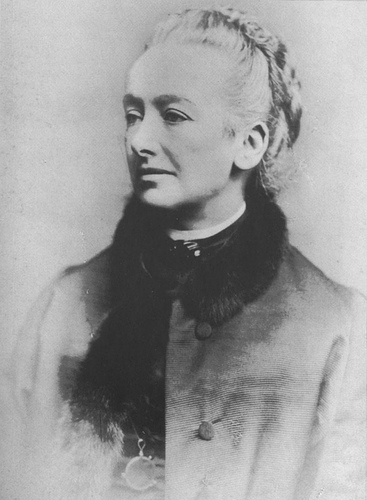
Amelia Ann Blandford Edwards toured Egypt during 1873-74 with friends and saw Egyptian artifacts needed to be preserved. In London, Amelia and Reginald Stuart Poole founded the Egypt Exploration Fund, which is now known as the Egypt Exploration Society.
Petrie was paid 250 British Pounds per month from the Fund to excavate in Egypt. In 1895 Petrie was excavating at Deir El-Bahari and excavated wooden items that have become known as "Petrie rockers". Petrie suspected these items were used for the construction of the Pyramids and his assumption has been proven correct.
Petrie had excavated wooden pinion-pulley lobe quadrants which are components of an ancient pulley hitherto unknown in the modern world. This pulley surrounds its load, which is a Pyramid block, and then as it is hoisted the pulley step-walks the Pyramid's stepped layers with a mechanical advantage of 2.8 (MA=2.8).
Petrie died in Jerusalem unknowing that "Petrie rockers" are components of an ancient pulley and one of the most important excavations he made.
The book "Raising Stone 1" is in the Egypt Exploration Society Library in London and explains the operation of the ancient Egyptian four‑lobe pinion‑pulley with relevant and specific background material.
A Pyramid progressively under construction already has four sides of steps upon which step-climbing pulleys can step-walk stones upward, similar to how three wheels of a step-trolley move over steps. Ancient Egyptian engineers were intelligent and innovative having built four Pyramids at least without using ramps, those of Pharaohs Sneferu (Red Pyramid), Khufu, Khafre & Menkaure.
Students of Ancient History are now discovering this ancient method of Pyramid construction by studying "Raising Stone 1"